
3D PRINTED HOUSES
Technology solution or the means for a monopoly?

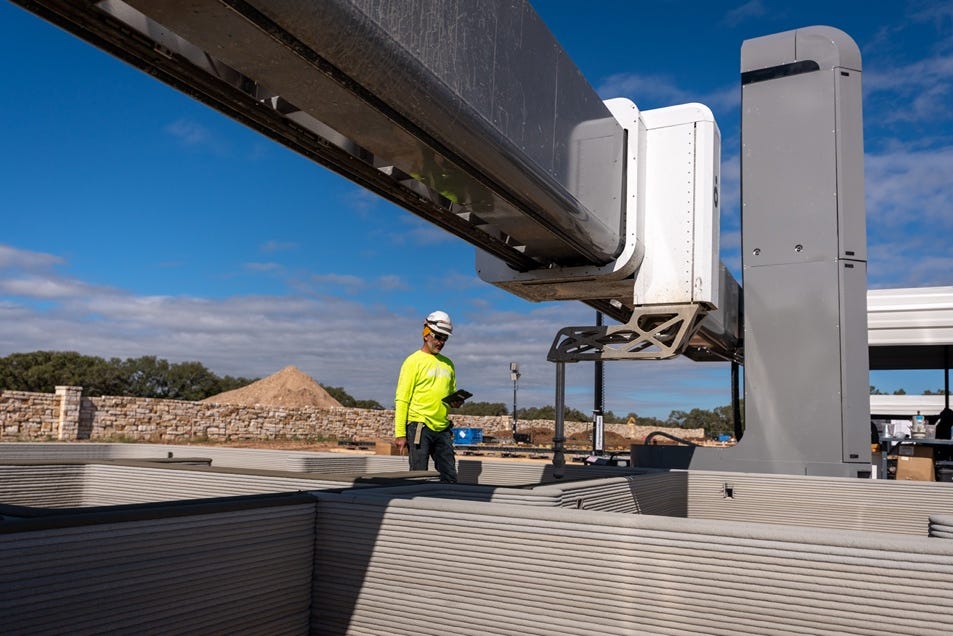
Bloomberg published an article recently about 3D printed houses being built in a collaboration between the tech company Icon and national homebuilder Lennar. Like many, I’m fascinated by the technology. But I’m probably alone in being skeptical of its ability to solve our housing crisis.
The merits of this system are well known. I’m just going to list my objections as a counterweight to all the uncritical coverage this technology has received thus far. There is still a lot to like about the technology itself. But if I’m wrong or off-base somewhere, please comment. So…
This machine has to be expensive. Your average framing crew can complete the shell of a house with less than $2,000 worth of tools. But when the cost of the tool is out of reach for 90 percent of small to medium size homebuilding companies, only the giants of the industry will be able to afford it. A machine like this is certain to take the means of production out of the hands of local home builders and give it to those who have Wall Street backing and debt financing.
The threat to local builders and mom-and-pop operations is the same threat Amazon posed to small bookstores and brick and mortar retailers in the late 1990s and early 2000s. Amazon didn’t turn a profit for the first seven years, but Wall Street kept throwing cash at Bezos because they calculated that the model would work. Once Amazon had destroyed the brick-and-mortar economy the company’s revenues and stock price took off. As late as 2010 Amazon stock was trading at about $6 a share. By 2022 it had reached $170 a share and vast majority of local retail operations that competed against it were out of business.
The same dynamic might very well play out with automated homebuilding systems. The financiers of the robots will undercut your prices until you’re out of business and then they’ll own the lion’s share of the market.
Crony capitalism. There is a lot of discussion today in business and political circles about “regulatory capture.” Another term for it is “crony capitalism.” This happens when the big corporations strong arm the government into passing laws that favor themselves over smaller competitors.
Would the inventors of machines like this and the big builders who buy them employ lobbyists to change building codes to favor their system? Of course they would. The invisible hand of capitalism will eventually demand it. Would elected officials resist machine-built houses if the machine were shown to be less socially desirable than traditional methods? Absolutely not. As long as big business talks, politicians will do its bidding.
John Henry. Some may claim this machine is more efficient than a framing crew. I don’t believe it. I’ve worked on framing crews that ranged from three to seven people and we never took more than a week or two to put a frame up, dry the roof in, and add the siding, windows and exterior trim.
If crews are running slower today, it’s because the average age of a construction worker is closer to men in their 40s and 50s. You need a healthy supply of 20- and 30-year-olds to build a house efficiently. And that’s a problem technology isn’t going to fix. The needless complexity of today’s new home designs, doesn’t help, but the floorplans and elevations of the Icon/Lennar homes are anything but complex.
Total lifecycle carbon footprint. The manufacture of cement creates giga-tons of CO2, about a pound of that gas for every pound of cement. Eight percent of the world’s CO2 cement production. Some contractors have the ability to demolish and recycle concrete as aggregate or fill, but the process is difficult and expensive.
Trees, however, absorb CO2 as they grow, and wood, timber and lumber are infinitely replenishable in the forest. Remodeling carpenters often reuse studs, joists and dimensional lumber. Whole companies have sprung up in the last decade selling weathered barn siding and old beams—much of it at a premium to new lumber. And left on the ground for a few decades, wood will return to the soil it came from as simple compost.
Technology vs community
In tribes, small groups and community efforts, people have been building their own homes without the intervention of Wall Street and mortgages for thousands of years. The Amish are still doing it. That was the norm until 150 years ago.
As the industrial revolution picked up steam and people migrated off the farm and into the cities and factories, specialization of labor made it expedient to hire local homebuilders. Costs went up, but mortgages and a robust economy kept the ball rolling. Then, 2008 happened. Wall Street and the mortgage industry imploded. By some estimates one out of every ten homes was threatened with foreclosure. Now homes are more expensive than ever and we’re still not building enough.
Adding a machine that “prints” houses into this already dysfunctional system is unlikely to do anything to ease homelessness or the housing crunch unless it can be proven the machine can create houses at a 40-percent discount to stick framing methods.
Icon’s 3D printing technology is a marvel of engineering. And it may have many applications other than the construction of homes. My concern is that pushing control of this fundamental human activity further into the control of the global equity markets will only make homes cost more and homelessness worse.
Egypt’s celebrated architect Hassan Fathy made this point in his acceptance speech for the 1980 Balzan Prize for Architecture and Urban planning. He also noted that mechanically contrived architecture, as contrasted with hand built with local orientation, leads to an alienation from nature and absurdities such as desert homes with vast expanses of energy-squandering glass that become uninhabitable the moment the power flickers off.
And it’s not like Fathy is a anti-technology Luddite curmudgeon. Google even celebrated his work in 2017 with one of its famous doodles. What Fathy was trying to tell us here is that technology must be oriented to serve humanity and not the other way around.
“A house,” said Frank Lloyd Wright, “is not a machine for living.” Nor can a machine make one.